I find it is easier to justify ridiculous purchases when it's close to my birthday. Not quite two weeks ago I got myself an iPad. Since I've had some time with the thing, I thought I'd make a few random comments, in no particular order or relatedness.
First, I don't travel in teen or even tween circles, so it has been some time since I got called names relating to my sexual orientation. Yet mentioning that I had got myself an iPad leaves some complete strangers with the urge to call me things — online, at least, where being a flaming jerk is some sign of conviction. It's very odd. There's a lot of bruhaha about restrictions on the iPod, but I don't really have anything to add to it. Howard Stearns had more interesting things to say about the matter already, and better than I could. Besides, I've lived all my professional life neck-deep in the Unix and free software world and I've always managed to live happily in mixed environments — open tools on closed OSes, open OSes running closed tools — whatever can be made to work reliably without going over-cost is fine by me. If I really want to program an iPad directly, I can always fire up jsforth.
I personally cannot stand laptops — this is a quirk, I realize. They're too big to be really convenient, and too small to be comfortable to use for very long. That the iPad doesn't try to be a laptop is actually a plus for me. I've had an iPod Touch for quite a while, and while one can visit web pages, read documents, compose email or post to web forums from it, it's really not very nice. On the iPad, this is all much more pleasant. The device was made for casual browsing at a coffee shop, and I've adjusted to the freaky keyboard fairly quickly.
I've been waiting for something like an iPad running something like the GoodReader app for more than 15 years. While I may be a professional computer geek by day, when not at work I turn into the Dilettante Philologist. I do use some of my computer skills for my dead language work of course, but my computing needs are very different when I'm on the Philologist setting. I've transferred a large stash of journal articles, old books, Helmut van Thiel's magnificent editions of the D scholia on the Iliad and Odyssey, PDFs of my own notes on Greek work to the iPad. Now when I'm waiting at the dentist's office I can once again try to comprehend Matic 's paper, Topic, focus, and discourse structure: Ancient Greek Word Order; or Dale's classic three papers on the metrical units of Greek lyric verse. The iPad may be a bit heavy for a mobile device, but it weighs considerably less than the print edition of the unabridged LSJ, which I have at my fingertips in the Lexiphanes application. I can only hope someone will write an application to interact with the Perseus corpus.
On a whim, I downloaded Charlie Stross' Iron Sunrise into the iBook application. I'm about three-quarters through the book. I'm a big lover of the traditional book format even for casual reading, but I have to say reading on the iPad has been very comfortable. The amusement value the over-wrought page-turning animation passed quickly enough, and I can read for hours at a stretch without the thing distracting me from the novel. The only small complaint I have is about some of the typesetting. For chapter and major section starts Iron Sunrise was probably typeset with a few words in small caps, but that font didn't make the transition to the iBooks app. The first three words are in slightly large all lowercase. More careful editing would fix this.
All said, I love this device, mostly because I know I can travel a lot lighter in the future (I used to have to be content with the Middle Liddell, heavy enough in carry-on). For me, the iPad is mostly a way to interact with text — lots and lots of text. Thanks to some development time with the iPad Touch and the iPhone, the iPad is awfully good at that. It'll be interesting to see what the next five years bring to the entire industry around devices like this.
Showing posts with label καὶ τὰ λοιπά. Show all posts
Showing posts with label καὶ τὰ λοιπά. Show all posts
16 April 2010

01 October 2009
Learning Greek through Greek
If you ever want to watch an amateur classicist go up in flames and start channelling Cicero at his most denunciatory and his least fair-minded, start up a conversation about the quality of Greek and Latin textbooks. A very few books may get positive comment, but for the most part these books aren't friendly to the autodidact. It's one reason why Textkit's forum is always going to be popular. While there are books I warn people away from, for the most part I don't usually get too agitated about textbooks. For the self-teacher, it is far more important to stick with one than it is to succumb to the temptation to churn through a dozen books hoping to find one that makes the middle perfect of consonant stem verbs easy to learn.
That said, I'm going to complain about Greek textbooks now. Well, make a slightly cranky observation.
When I was in high school, by the time I got to the second year of French and German, the textbooks we used were introducing some grammatical material in the language being taught, along with obvious things like calling chapters chapitres and describing the requirements of homework auf Deutsch. Even the mechanics of day-to-day classroom work were turned into another opportunity to use the languages which, in theory, the classes were supposed to impart. I have seen a few Latin textbooks which do use Latin for more than just the exercises. The only book I've run across doing this in Greek was published in Spain in 1856 (Google Books), and that's clearly an advanced book.
So, it seems to me that by the time you start learning about -μι verbs you should be seeing Greek not only in the terrifying new construction the lesson presents, in the idiotic practice sentences and in whatever adapted passage of literature that lesson has, but also as the chapter headings, in the notes explaining tricky parts of that adapted passage, etc. On the other hand, I've recently been working on a page for Scholiastae.org which describes ancient Greek grammatical vocabulary, Greek Grammar in Greek, intended for people who don't want to drop to English in the Greek- and Latin-only sub-forum. There's a lot of Greek grammatical vocabulary. The beginner to Greek already has to learn to cope with strange incantations like "aorist middle optative" in their native language. Are the benefits of seeing more Greek worth the cost of learning the substantial technical vocabulary when lots of more basic vocabulary also needs to be learned? Since no one is forced to learn Greek any more, I'm inclined to see value in laying on Greek as thickly as possible for those few who do decide to take it up.
That said, I'm going to complain about Greek textbooks now. Well, make a slightly cranky observation.
When I was in high school, by the time I got to the second year of French and German, the textbooks we used were introducing some grammatical material in the language being taught, along with obvious things like calling chapters chapitres and describing the requirements of homework auf Deutsch. Even the mechanics of day-to-day classroom work were turned into another opportunity to use the languages which, in theory, the classes were supposed to impart. I have seen a few Latin textbooks which do use Latin for more than just the exercises. The only book I've run across doing this in Greek was published in Spain in 1856 (Google Books), and that's clearly an advanced book.
So, it seems to me that by the time you start learning about -μι verbs you should be seeing Greek not only in the terrifying new construction the lesson presents, in the idiotic practice sentences and in whatever adapted passage of literature that lesson has, but also as the chapter headings, in the notes explaining tricky parts of that adapted passage, etc. On the other hand, I've recently been working on a page for Scholiastae.org which describes ancient Greek grammatical vocabulary, Greek Grammar in Greek, intended for people who don't want to drop to English in the Greek- and Latin-only sub-forum. There's a lot of Greek grammatical vocabulary. The beginner to Greek already has to learn to cope with strange incantations like "aorist middle optative" in their native language. Are the benefits of seeing more Greek worth the cost of learning the substantial technical vocabulary when lots of more basic vocabulary also needs to be learned? Since no one is forced to learn Greek any more, I'm inclined to see value in laying on Greek as thickly as possible for those few who do decide to take it up.
22 August 2009
The Tablet of Cebes, or, A Gap in my Education
Recently a Textkit study group has formed to read the Discourses of Epictetus. Naturally I slurped up the text into Scholiastae, and one scholiastic activity I've been involved in is creating a list of the most common Stoic terms and idioms used in Epictetus. A few weeks ago, in the course of my hunting down references, I discovered that Keith Seddon (“The Stoic who Never Sleeps”) in 2005 came out with a translation of Epictetus' Enchiridion. In addition to the Enchiridion, however, the book contains a translation of the Tablet of Cebes — a work I had never heard of until that point.
It turns out the Tablet was once frequently paired with the Enchiridion, with Theophrastus' Characters often rounding out the collection. The Tablet is a brief, 1st century dialog introducing Plato's puzzling doctrine of pre-existence, and the value of philosophy in general (it is invariably compared to Pilgrim's Progress in English references).
It is astonishing to me that the Tablet has no showing in any of the many introductory and intermediate Greek textbooks I have seen in my life. The work, along with its usual company, was once quite popular, both in Greek and in translation — into Latin, of course, but also into European vernaculars and even Arabic. It seems well suited to beginners in Greek. The language is not too trickified; it is short and could be read entirely in even a quarter-system school schedule; it introduces philosophy, a subject which doubtless draws more people to Greek in the first place than does Xenophon; one can even bring in discussion about Hellenistic and Imperial intellectual trends — how many philosophical dialogs start with ekphrasis?
The Wondrous Textual Powers of the Internet give us several reading options.
Drosihn's 1871 Teubner seems to still be the standard critical edition, but I'll gladly hear correction about that. It is available on Google Books, a copy of which is also at Archive.org.
C.S. Jerram of Oxford has a 1878 school-boy edition with extensive notes, including many useful to those with wobbly Greek. Again available via Google Books, with a copy of the Google scan at Archive.org.
Richard Parsons brought some Yankee ingenuity (well, Ohio Wesleyan ingenuity) to Cebes, producing a 1897 edition with less copious notes. It does, however, have a brief vocabulary at the end, which makes his book prime bus-to-work reading material. There are several indifferently produced off-prints on the market now, but if you don't love your printer too much, there are again both Google Books and independent Archive.org editions.
There is a 1997 Bryn Mawr Greek commentary by T.M. Banchich, about which I can find little information.
A project at the Université catholique de Louvain has text versions (in Greek and French). I am as yet uncertain, given the editorial markings, of the provenance of their text. And I do wish they had a clear statement of copyright for this very tasty pot pourri.
Finally, Archive.org houses a rather florid 1910 English translation — to say nothing of the typesetting — The Greek Pilgrim's progress; generally known as The picture.
It turns out the Tablet was once frequently paired with the Enchiridion, with Theophrastus' Characters often rounding out the collection. The Tablet is a brief, 1st century dialog introducing Plato's puzzling doctrine of pre-existence, and the value of philosophy in general (it is invariably compared to Pilgrim's Progress in English references).
It is astonishing to me that the Tablet has no showing in any of the many introductory and intermediate Greek textbooks I have seen in my life. The work, along with its usual company, was once quite popular, both in Greek and in translation — into Latin, of course, but also into European vernaculars and even Arabic. It seems well suited to beginners in Greek. The language is not too trickified; it is short and could be read entirely in even a quarter-system school schedule; it introduces philosophy, a subject which doubtless draws more people to Greek in the first place than does Xenophon; one can even bring in discussion about Hellenistic and Imperial intellectual trends — how many philosophical dialogs start with ekphrasis?
The Wondrous Textual Powers of the Internet give us several reading options.
Drosihn's 1871 Teubner seems to still be the standard critical edition, but I'll gladly hear correction about that. It is available on Google Books, a copy of which is also at Archive.org.
C.S. Jerram of Oxford has a 1878 school-boy edition with extensive notes, including many useful to those with wobbly Greek. Again available via Google Books, with a copy of the Google scan at Archive.org.
Richard Parsons brought some Yankee ingenuity (well, Ohio Wesleyan ingenuity) to Cebes, producing a 1897 edition with less copious notes. It does, however, have a brief vocabulary at the end, which makes his book prime bus-to-work reading material. There are several indifferently produced off-prints on the market now, but if you don't love your printer too much, there are again both Google Books and independent Archive.org editions.
There is a 1997 Bryn Mawr Greek commentary by T.M. Banchich, about which I can find little information.
A project at the Université catholique de Louvain has text versions (in Greek and French). I am as yet uncertain, given the editorial markings, of the provenance of their text. And I do wish they had a clear statement of copyright for this very tasty pot pourri.
Finally, Archive.org houses a rather florid 1910 English translation — to say nothing of the typesetting — The Greek Pilgrim's progress; generally known as The picture.
13 July 2009
Well, that's one way to curate
One thing I was concerned about after the death of Bill Harris was that his magnificent web site would silently disappear some day. I was happy to see this notice today:
I'm certainly not going to complain about this... but I still wonder what a librarian would think about this approach. "Just leave it there" may not be the best way to go in the long (permanent) run. I'm not sure anyone knows the answer to these questions yet.
Bill truly enjoyed sharing with all of you, and he greatly appreciated the contact he had with so many of you from around the world, especially in his latter years. We invite you to continue using and enjoying his web site. Bill Harris' web site will be maintained on the Internet permanently as part of the digital archives of Middlebury College.
I'm certainly not going to complain about this... but I still wonder what a librarian would think about this approach. "Just leave it there" may not be the best way to go in the long (permanent) run. I'm not sure anyone knows the answer to these questions yet.
30 March 2009
Internet Stemmatics
In June 2005 the Times Literary Supplement carried an article by Martin West containing a much fuller version of Sappho 58 than we'd had before. The extra text had been found in mummy cartonnage at the University of Cologne. This was cause for great excitement, and it didn't take very long at all for a transcription to appear on the Classics-L mailing list.
Unfortunately, there was a small problem — there were two typos in the text, one a spacing issue, and one an interesting metagrammatism — *ἔμαπψε for ἔμαρψε — presumably caused by interference between English "P" and Greek "Ρ" (rho, an /r/ sound). Within hours of appearing on the mailing list, however, the poem — with errors — was all over the internet, on blogs and web pages. There are still some sites that have these errors.
I've recently started loading up Scholiastae.org with some of the major texts, to make it easy for people to drop scholia in without having to deal with some of the initial wikification of a large text (dividing into sections, line number marking, etc.). So I've been spending time looking over already-digitized texts of authors available on the web, which don't appear to be breaking copyright rules and which will be easily converted into wiki format.
When deciding on a text to use for Hesiod's Theogony, I realized that all but a tiny handful of versions of that on the web are from a single source, apparently based on Rzach's old Teubner edition. I know they're from the same source because they all contain the same error in line 268:
αἵ ῥ᾽ ἀνέμων πνοιῇσι καὶ οἰωνοῖς ἕμ᾽ ἕπονται
The underlined word is nonsense, a corruption of elided ἅμα which anticipates the start of the next word — a common enough scribal error. Last time I googled, only four hits show up on that line with the correct ἅμ’, though I've fixed copies I've found on open wikis, and I'll be sending out a few pieces of email. But I do wonder how long the error will persist.
04 January 2009
New Year's Gallimaufry
2008 was not a year of many blog posts. I thought I'd make a few random comments, before moving on to 2009.
I got my house re-sided at the end of the summer. Naturally, I take out a substantial debt to pay for this, just before the market exploded. My timing is, as always, impeccable.
The last few months of the year saw me start playing music again. In another month I hope to have my callouses back enough that I can slide notes on my mandolin without slicing open my fingers. I also went off the deep end, and got a 5-string banjo, on which I play old-time and celtic tunes — no bluegrass for me, thanks. In part, I blame Cathy Moore for playing all those funky, non-old-time tunes on the 5-string and making it work.
To make time for the music, my desultory attempts to get Latin back into my brain have been shut down.
I've mostly been reading Greek prose the last few months, but I have several things in the pipeline for Aoidoi. These will not see fruition for a month or so. A piece of web software I would love for Aoidoi does not yet exist, but I am afraid to write it.
Given the lovely state of the economy, paying to take classes in Greek seems like an extravagance right now. I'll probably not be doing that in the next year. Another sign of the economy and the strange state of contemporary American politics — for the first time in her 80 years, my grandmother voted Democratic last November.
I never had warts as a child, but I enter 2009 with a giant one on my face — very attractive. Good thing I don't believe in omens.
I got my house re-sided at the end of the summer. Naturally, I take out a substantial debt to pay for this, just before the market exploded. My timing is, as always, impeccable.
The last few months of the year saw me start playing music again. In another month I hope to have my callouses back enough that I can slide notes on my mandolin without slicing open my fingers. I also went off the deep end, and got a 5-string banjo, on which I play old-time and celtic tunes — no bluegrass for me, thanks. In part, I blame Cathy Moore for playing all those funky, non-old-time tunes on the 5-string and making it work.
To make time for the music, my desultory attempts to get Latin back into my brain have been shut down.
I've mostly been reading Greek prose the last few months, but I have several things in the pipeline for Aoidoi. These will not see fruition for a month or so. A piece of web software I would love for Aoidoi does not yet exist, but I am afraid to write it.
Given the lovely state of the economy, paying to take classes in Greek seems like an extravagance right now. I'll probably not be doing that in the next year. Another sign of the economy and the strange state of contemporary American politics — for the first time in her 80 years, my grandmother voted Democratic last November.
I never had warts as a child, but I enter 2009 with a giant one on my face — very attractive. Good thing I don't believe in omens.
12 November 2008
In Praise of Little Ideas
While it is true that there are plenty of science fiction authors who are writerly, whose language shows signs of care beyond the bare need to tell the story, it is nonetheless the case that most of such literature is read for the ideas. A good number of these ideas are conventional, a well-worn path the experienced reader of science fiction uses to get up to speed on whatever it is the author is about to do that's new.
Though I might appreciate The Big Idea in many of these books as a way to generate a story or to work out the idea, an awful lot of the time I don't consider The Big Idea terribly plausible. From time to time, however, I do run across a Little Idea — a one-off or a minor point — that strikes me as either absolutely true or a Really Good Idea.
For example, in one book, the title of which I cannot even remember, is a scene in a giant space ship several kilometers in length. Charlie Stross has convinced me that travel between solar systems is monumentally impractical, as much magic as dragons and rings of power. In any case, in this book the computing subsystems all over the ship were a pain in the ass to deal with because they were all kept on isolated networks. It turns out most of the ship's computers were riddled with viruses and couldn't be connected safely. This, sadly, strikes me as all too likely, should it ever happen that we have a legitimate reason to build such ships.
In Vernor Vinge's most recent book, Rainbows End, he makes occasional mention of the "Friends of Privacy," an organization that produces lots of false information about people all over the internet, with the goal of concealing people who want a little privacy in a world of ubiquitous online presence and data recording. This seems to me at least a possible development, and, frankly, given the growth of the participatory panopticon, a desirable one.
I have recently been reading Neal Stephenson's latest tome, Anathem. Because it's Neal Stephenson book it has quite a few Big Ideas. You can read the overview at the link, but the main point I'm interested in here is the world of this book, scholars are sequestered away in things quite like convents — here called "concents" — while the outside world goes on without them. Once a year doors are opened which allow those inside and those outside to mingle for about a week. Within the concents populations are sequestered from each other, too, so that the "centenarians," for example, only encounter the outside world once every hundred years. Within the concents people select different specialties — physics, philosophy, math, etc. One brilliant Little Idea mentioned a few times in passing and with a minor role late in the book is the order known as the Lorites,
People who've spent a lot of time with me have heard me complain that the field of computer science seems so consistently and utterly ignorant of its own intellectual past. This is a field that desperately needs Lorites. Granted, about half of the time our CS Lorites would be saying one of three things — (1) Lisp did this in 1960-mumble; (2) Alan Kay's group did this in 1970-mumble; or (3) MULTICS — but there'd still be plenty of work for them. Lots of fields of study could probably use a Lorite or two in the department. It would certainly save wasted paper on pointless dissertations and books.
Though I might appreciate The Big Idea in many of these books as a way to generate a story or to work out the idea, an awful lot of the time I don't consider The Big Idea terribly plausible. From time to time, however, I do run across a Little Idea — a one-off or a minor point — that strikes me as either absolutely true or a Really Good Idea.
For example, in one book, the title of which I cannot even remember, is a scene in a giant space ship several kilometers in length. Charlie Stross has convinced me that travel between solar systems is monumentally impractical, as much magic as dragons and rings of power. In any case, in this book the computing subsystems all over the ship were a pain in the ass to deal with because they were all kept on isolated networks. It turns out most of the ship's computers were riddled with viruses and couldn't be connected safely. This, sadly, strikes me as all too likely, should it ever happen that we have a legitimate reason to build such ships.
In Vernor Vinge's most recent book, Rainbows End, he makes occasional mention of the "Friends of Privacy," an organization that produces lots of false information about people all over the internet, with the goal of concealing people who want a little privacy in a world of ubiquitous online presence and data recording. This seems to me at least a possible development, and, frankly, given the growth of the participatory panopticon, a desirable one.
I have recently been reading Neal Stephenson's latest tome, Anathem. Because it's Neal Stephenson book it has quite a few Big Ideas. You can read the overview at the link, but the main point I'm interested in here is the world of this book, scholars are sequestered away in things quite like convents — here called "concents" — while the outside world goes on without them. Once a year doors are opened which allow those inside and those outside to mingle for about a week. Within the concents populations are sequestered from each other, too, so that the "centenarians," for example, only encounter the outside world once every hundred years. Within the concents people select different specialties — physics, philosophy, math, etc. One brilliant Little Idea mentioned a few times in passing and with a minor role late in the book is the order known as the Lorites,
Lorite: A member of an Order founded by Saunt [< Savant — Wm] Lora, who believed that all of the ideas that the human mind was capable of coming up with had already been come up with. Lorites are, therefore, historians of thought who assist other avout in their work my making them aware of others who have thought similar things in the past, and thereby preventing them from re-inventing the wheel.
People who've spent a lot of time with me have heard me complain that the field of computer science seems so consistently and utterly ignorant of its own intellectual past. This is a field that desperately needs Lorites. Granted, about half of the time our CS Lorites would be saying one of three things — (1) Lisp did this in 1960-mumble; (2) Alan Kay's group did this in 1970-mumble; or (3) MULTICS — but there'd still be plenty of work for them. Lots of fields of study could probably use a Lorite or two in the department. It would certainly save wasted paper on pointless dissertations and books.
07 September 2008
Patsy Cline Greeked
About a month ago my iPod handed me a classic Patsy Cline tune, Leaving on your Mind. For some reason I decided the song needed to be translated into ancient Greek. I decided on quatrains of glyconics (xx-uu-u-) with the occasional anaclastic glyconic, a.k.a. the choriambic dimeter, xx-x-uu-. Here's the original:
If you've got leavin' on your mind
Tell me now, get it over
Hurt me now, get it over
If you've got leavin' on your mind
If there's a new love in your heart
Well, tell me now, get it over
Hurt me now, get it over
If there's a new love in your heart
Don't leave me here
In a world filled with dreams that might have been
Hurt me now, get it over
I may learn to love again
If there's a new love in your heart
Well, tell me now, get it over
Hurt me now, get it over
If there's a new love in your heart
Hurt me now, get it over
If there's a new love in your heart
I removed some of the repeats. I indulged in an outrageous aeolic future infinitive — ἀπολειψέμεν — using a verb Lucian disapproved of for men to describe "leaving." However, I don't think ἐκπέμπω quite captures the right feel for "leaving" in this song.
εἰ μέλλεις ἀπολειψέμεν,
ἐμοὶ μὲν λέγε νῦν τελῶν,
πήμηνον δέ με νῦν τελῶν
εἰ μέλλεις ἀπολειψέμεν.
εἰ δ’ ἐν θυμῷ καινὸς ἔρως,
ἐμοὶ μὲν λέγε νῦν τελῶν,
πήμηνον δέ με νῦν τελῶν
εἰ δ’ ἐν θυμῷ καινὸς ἔρως.
στᾶσαν ἐνθάδε μὴ λίπῃς
παθοῦσάν τέ με καὶ μάτην.
πήμηνον δέ με νῦν τελῶν,
ἀλλ’ αὖθίς πού μοι φιλία.
In my first pass I bungled the meter of the third line from the end. I'm still not certain about my repairs there.
04 August 2008
Gentium in Emacs via Unicode
I spent a little time over the weekend tweaking my Carbon Emacs configuration. When I first started using it I had to spend several interesting hours to get it to use a Mac-ish font large enough that I didn't go blind. I settled on a 15 point Vera Sans Mono. Unfortunately, the Greek that it picks for this isn't so nice. So with a little more digging, I managed to get Emacs to use Gentium for the Greek, but it had to be tweaked a bit for size:
Yes, it really does take an 18 point Gentium to match a 15 point Vera Sans Mono.
My next step was to tweak the fontset to include Cuneiform (via the nice Neo-Assyrian Assurbanipal font), but MULE, Emacs' internationalization library, chokes on Unicode code points in in the 0x12000's where Cuneiform lives. I suppose my commentary on the Enûma Eliš focused on interpretive dance will have to wait.
;;; Greek extended
(set-fontset-font
 "fontset-default"
 (cons (decode-char 'ucs #x1f00)
       (decode-char 'ucs #x1fef))
 "-apple-gentium-medium-r-normal--18-180-72-72-m-180-iso10646-1")

;; "Greek and Coptic"  U+0374 - U+03FB
(set-fontset-font
 "fontset-default"
 (cons (decode-char 'ucs #x0374)
       (decode-char 'ucs #x03fb))
 "-apple-gentium-medium-r-normal--18-180-72-72-m-180-iso10646-1")
Yes, it really does take an 18 point Gentium to match a 15 point Vera Sans Mono.
My next step was to tweak the fontset to include Cuneiform (via the nice Neo-Assyrian Assurbanipal font), but MULE, Emacs' internationalization library, chokes on Unicode code points in in the 0x12000's where Cuneiform lives. I suppose my commentary on the Enûma Eliš focused on interpretive dance will have to wait.
16 May 2008
Roots and Tendrils
I've been hammering away at a Common Lisp library for SVG. Last week I decided to take a break from studying the arcana of clipping windows and alpha masks to see if I could translate some of the gallery examples from NodeBox into SVG nicely. My library isn't ready for Graphic Cellular Domestication — that'll take Javascript — but some of the random walk ones turned out ok:
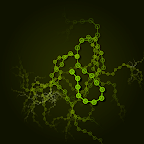
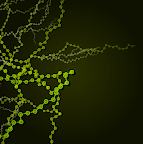
I quite like my modification of the tendrils algorithm, if I do say so myself:
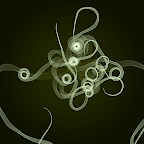
Of course, SVG isn't recognized as an uploadable image format many places, so the pictures are PNG.
I quite like my modification of the tendrils algorithm, if I do say so myself:
Of course, SVG isn't recognized as an uploadable image format many places, so the pictures are PNG.
26 February 2008
Somewhere a cardiologist got their wings
Last week a group of us had dinner and tasty if a bit snooty beers at Brasserie V. One appetizer was almond-stuffed dates wrapped in bacon. These were so good that it was decided the recipe should be reproduced at this week's Geeks' Night In. So, along with the evening's bottling and brewing of beer, dates were stuffed, wrapped in bacon, skewered, lightly sprinkled with brown sugar and broiled.
Our version was also delicious. My brilliant innovation came when I spied the loaf of French bread looking lonely on the table. I ripped a hunk off, and dipped it into the date-flavored bacon fat left in the broiling pan. Everyone else was appalled — including, I hasten to add, Chuck. Until they tried it.
Our version was also delicious. My brilliant innovation came when I spied the loaf of French bread looking lonely on the table. I ripped a hunk off, and dipped it into the date-flavored bacon fat left in the broiling pan. Everyone else was appalled — including, I hasten to add, Chuck. Until they tried it.
17 February 2008
I should be studying...
Instead I did this:


I blame Nicholas' recent posts.
I had brief anxieties when the wind and the cold really started. Branches were falling off neighbors' trees and my working area was right under some suspicious branches. I was ready to bolt at the first hint of a crack above me.
14 February 2008
It's the little things: Lisp + Unicode
This little snippet of code makes me giddy out of proportion to what it accomplishes:
That this is so easy is a lucky accident of Common Lisp's history. The "common" in Common Lisp is because it was supposed to unite several popular (hey, it was the 80s), but incompatible, Lisp variants. There were lots more kinds of computers in wide use in the 80s, and many different encoding schemes for text. Thus, Common Lisp
Well, the betacode to unicode conversion library works. Next up, indexing Perseus' exotic XML texts.
 ;; A non-final sigma cannot occur at the end of the string.
 (when (char= (elt uni (1- (length uni))) #\σ)
   (setf (elt uni (1- (length uni))) #\ς))
That this is so easy is a lucky accident of Common Lisp's history. The "common" in Common Lisp is because it was supposed to unite several popular (hey, it was the 80s), but incompatible, Lisp variants. There were lots more kinds of computers in wide use in the 80s, and many different encoding schemes for text. Thus, Common Lisp
strings were always arrays of characters which were not necessarily bytes, or even ASCII. EBCDIC, anyone?Well, the betacode to unicode conversion library works. Next up, indexing Perseus' exotic XML texts.
04 February 2008
Weekend Puzzlements
1) If the system name of the DTD is a 404-ed URL is your XML document valid?
2) What's the point of a DTD, anyway, if you're just going to obliterate it when you think up something cleverer?
3) Anyone who thinks the modern world is "too coldly rational" isn't paying attention.
2) What's the point of a DTD, anyway, if you're just going to obliterate it when you think up something cleverer?
3) Anyone who thinks the modern world is "too coldly rational" isn't paying attention.
02 January 2008
APA Pre-game
Tomorrow I head to Chicago for the 2008 Annual Meeting of the APA. The last non-work conference I spent my own money on was the 1999 Congress of the Esperanto League of North America in St. Louis. I'd guess there'll be fewer aged socialists at the APA, but, given the increasingly mercantile nature of US universities, it may not be a less quixotic enterprise.
For the last two months there has been a painful Saga of Wm's Tooth, and I had some anxiety that I'd be in pain for the entire APA, but an emergency root canal on December 28th has solved all problems. I just need not to swallow the temporary crown.
I have a laptop, and the hotel has wireless, so I will be conference blogging. Of course I'll be focusing on sessions on Greek verse of any period — there's an entire session on Homer — Linguistics, and computer-classics hybrid geekery. There's nothing especially Greeky in one time slot, so I'll probably attend the Catullus session. I'll probably also hit the evening workshop for the Society for the Oral Reading of Greek and Latin Literature if I'm not camped out at Russian Tea Time sucking down kasha and currant tea.
I was disappointed to learn there is no discount at the book stalls until the last day, at which point it becomes a feeding frenzy, with dignified giants in the field sprinting like new-born fawns and gnawing off would-be competitors' arms in the ruckus.
I just hope Madison doesn't wash away when all that snow melts Sunday and Monday. I'll try not to worry about it.
For the last two months there has been a painful Saga of Wm's Tooth, and I had some anxiety that I'd be in pain for the entire APA, but an emergency root canal on December 28th has solved all problems. I just need not to swallow the temporary crown.
I have a laptop, and the hotel has wireless, so I will be conference blogging. Of course I'll be focusing on sessions on Greek verse of any period — there's an entire session on Homer — Linguistics, and computer-classics hybrid geekery. There's nothing especially Greeky in one time slot, so I'll probably attend the Catullus session. I'll probably also hit the evening workshop for the Society for the Oral Reading of Greek and Latin Literature if I'm not camped out at Russian Tea Time sucking down kasha and currant tea.
- laptop: acquired and charged, useful software installed (solving my travel anxiety problem)
- bookbag: cleaned out and reloaded with moleskine cahiers and printouts of confirmation numbers
- Hero fountain pens: freshly loaded up with the terrifying inks I favor, packed
- luggage: nearly packed
- portable school edition of Alcestis with notes and vocab: tucked in coat pocket
I was disappointed to learn there is no discount at the book stalls until the last day, at which point it becomes a feeding frenzy, with dignified giants in the field sprinting like new-born fawns and gnawing off would-be competitors' arms in the ruckus.
I just hope Madison doesn't wash away when all that snow melts Sunday and Monday. I'll try not to worry about it.
27 November 2007
Before officers had pistols
Xenophon's Anabasis 1.3.1:
Greeks! What can you do with these people?
ἐνταῦθα ἔμεινεν ὁ Κῦρος καὶ ἡ στρατιὰ ἡμέρας εἴκοσιν· οἱ γὰρ στρατιῶται οὐκ ἔφασαν ἰέναι τοῦ πρόσω· ὑπώπτευον γὰρ ἤδη ἐπὶ βασιλέα ἰέναι· μισθωθῆναι δὲ οὐκ ἐπὶ τούτῳ ἔφασαν. πρῶτος δὲ Κλέαρχος τοὺς αὑτοῦ στρατιώτας ἐβιάζετο ἰέναι· οἱ δ᾽ αὐτόν τε ἔβαλλον καὶ τὰ ὑποζύγια τὰ ἐκείνου, ἐπεὶ ἄρξαιντο προϊέναι. Κλέαρχος δὲ τότε μὲν μικρὸν ἐξέφυγε μὴ καταπετρωθῆναι, ὕστερον δ᾽ ἐπεὶ ἔγνω ὅτι οὐ δυνήσεται βιάσασθαι, συνήγαγεν ἐκκλησίαν τῶν αὑτοῦ στρατιωτῶν.
There Cyrus and the army remained for twenty days, because the soldiers said they would would not go forward. They now suspected that they were going against the great king, and they said they hadn't been paid for that. Clearchus was the first to try to make his army go. They pelted him and the pack animals whenever they tried to go forward. Clearchus then fled for a bit so as not to get stoned to death, and later, when he realized he'd not be able to force them, called an assembly of his own troops.
Greeks! What can you do with these people?
15 November 2007
The Astronautilia and the shadow of Homer
A bit more than a year ago I mentioned the Astronautilia and its author, Jan Křesadlo. Thanks to the help of his son, who very kindly sent me a PDF copy of the Greek portion of the manuscript (all of it), I can now present the opening to that work: Astronautilia (PDF).
As in the Ode to Stalin, Křesadlo's use of the heroic hexameter is sometimes a bit of a shock. When I first started reading the Astronautilia I found this a bit off-putting. Now I'm inclined to look on this more favorably, even if not all of his verses are things you'd want to show to a tutor at Oxford, say, for fear of inducing a stroke.
Based on current web logs, the commentary I did on Theocritus 13 may go down in Aoidoi.org history as the least popular effort ever — worse even than the notes on Pindar. I myself came away from working on that with a sense that Theocritus, and the Alexandrian poets in general, were on the near edge of artistic panic thanks to the overwhelming shadow of Homer. Part of this impression may come from my choice of reading to prepare for Theocritus, but it's hard not to see the dialect, the curious twisting of Homeric words and phasing, and the bucolic digressions as a desperate attempt to get out of that massive shadow. Right now I'm not sure I want to read Theocritus again, but I have some sympathy for the guy. He made a good effort to make the hexameter his own.
Having seen Theocritus' struggles, I'm now a lot more kindly disposed toward Křesadlo's sometimes radical innovations in his Epic hexameters. He observed the licenses Homer allowed himself and then ran with those ideas. The manuscript as sent to me — I don't know if it appears in the edition with the facing Czech translation — has a glossary of "unusual forms and words." In that you can really see Křesadlo taking hold of Epic Greek and making it serve his own purposes. Excepting the imports from Modern Greek, his process is clearly modeled on variations found in standard Epic Greek. The very first line announces he's not producing a school exercise in the style of Homer:
In Epic the preposition represented in Attic by ἐν, "in," has two additional metrical variants, ἐνί and εἰν. There is no metrical reason at all to lengthen the preposition ἐξ, "out (of)," but Křesadlo has produced a free Homerism, εἰξ, unexampled in any Greek I've ever seen.
There are curiosities of declension:
He produces numerous doublets, giving him several metrical choices for a single word:
"Robot" got special attention, as is appropriate in science fiction, with no fewer than four forms: ῥόβοτος -ου ὁ, ῥοβότης -ου ὁ, ῥόβως -ωτος ὁ, ῤουβώτης -ου ὁ, as well as ῥοβότη ἡ “she-robot.” My favorite definition is φεῖσρος -ου ὁ “fazer - an established sci-fi weapon shooting pernicious rays.” The resulting mix of Homeric phrasing and robots is interesting (Αν. ι. 25, p.89):
His freedom with the hexameter is also on display in this line. And he hasn't just used the Epic dialect for his art. He grabbed the scholarly apparatus of ancient texts and turned that into part of the work, too — sometimes he marks his own lines as doubtful, putting them [in square brackets.]
With the possible exception of Nonnos' Dionysiaca, the Astronautilia has to be the most wild and even disorienting appropriation of Homeric language I have ever seen, and am ever likely to see. I simply cannot imagine what motivated Křesadlo to produce such a work, and my innocence of the Czech language leaves me with little chance to compare this with his other works. But even with the shocks of meter I can't help but be delighted the Astronautilia exists.
As in the Ode to Stalin, Křesadlo's use of the heroic hexameter is sometimes a bit of a shock. When I first started reading the Astronautilia I found this a bit off-putting. Now I'm inclined to look on this more favorably, even if not all of his verses are things you'd want to show to a tutor at Oxford, say, for fear of inducing a stroke.
Based on current web logs, the commentary I did on Theocritus 13 may go down in Aoidoi.org history as the least popular effort ever — worse even than the notes on Pindar. I myself came away from working on that with a sense that Theocritus, and the Alexandrian poets in general, were on the near edge of artistic panic thanks to the overwhelming shadow of Homer. Part of this impression may come from my choice of reading to prepare for Theocritus, but it's hard not to see the dialect, the curious twisting of Homeric words and phasing, and the bucolic digressions as a desperate attempt to get out of that massive shadow. Right now I'm not sure I want to read Theocritus again, but I have some sympathy for the guy. He made a good effort to make the hexameter his own.
Having seen Theocritus' struggles, I'm now a lot more kindly disposed toward Křesadlo's sometimes radical innovations in his Epic hexameters. He observed the licenses Homer allowed himself and then ran with those ideas. The manuscript as sent to me — I don't know if it appears in the edition with the facing Czech translation — has a glossary of "unusual forms and words." In that you can really see Křesadlo taking hold of Epic Greek and making it serve his own purposes. Excepting the imports from Modern Greek, his process is clearly modeled on variations found in standard Epic Greek. The very first line announces he's not producing a school exercise in the style of Homer:
ἀρχόμενος πρῶτον Μουσῶν χορῷ εἰξ Ἑλικῶνος
In Epic the preposition represented in Attic by ἐν, "in," has two additional metrical variants, ἐνί and εἰν. There is no metrical reason at all to lengthen the preposition ἐξ, "out (of)," but Křesadlo has produced a free Homerism, εἰξ, unexampled in any Greek I've ever seen.
There are curiosities of declension:
ἄνηρες = ἄνερες = ἄνδρες (influenced by Modern, Greek, evidently)
κύωνες = κύνες modeled on ἄνηρες
He produces numerous doublets, giving him several metrical choices for a single word:
ἑλκήθρος -ου ὁ = ἑλκήθρον -ου τό "sledge"
ἐξίσωσις -εως ἡ = ἐξισώοσις "equation," a shocking reinterpretation of Epic distraction
"Robot" got special attention, as is appropriate in science fiction, with no fewer than four forms: ῥόβοτος -ου ὁ, ῥοβότης -ου ὁ, ῥόβως -ωτος ὁ, ῤουβώτης -ου ὁ, as well as ῥοβότη ἡ “she-robot.” My favorite definition is φεῖσρος -ου ὁ “fazer - an established sci-fi weapon shooting pernicious rays.” The resulting mix of Homeric phrasing and robots is interesting (Αν. ι. 25, p.89):
βῆν ἴμεν πρὸς πτολίεθρον ἐγὼ καὶ Φράντα ῥοβώτης
His freedom with the hexameter is also on display in this line. And he hasn't just used the Epic dialect for his art. He grabbed the scholarly apparatus of ancient texts and turned that into part of the work, too — sometimes he marks his own lines as doubtful, putting them [in square brackets.]
With the possible exception of Nonnos' Dionysiaca, the Astronautilia has to be the most wild and even disorienting appropriation of Homeric language I have ever seen, and am ever likely to see. I simply cannot imagine what motivated Křesadlo to produce such a work, and my innocence of the Czech language leaves me with little chance to compare this with his other works. But even with the shocks of meter I can't help but be delighted the Astronautilia exists.
Subscribe to:
Posts (Atom)
